.png)
Golden Age, Golden Fashion: Women’s Dress in the Tang Dynasty
.webp)
The Progression of Tang Dynasty Fashion
Chinese history spans a whopping 5,000 years. Within this massive history are periods with great beauty and prosperity as well as grave wars and strife. But throughout Chinese history there has only been one period considered a Golden Age, the Tang Dynasty lasting approximately 300 years. Full of economic prosperity, artistic beauty, and a vast amount of foreign trade, this dynasty was radically different from any other dynasty. What made this period such a unique time for women was not only the artistic freedom made possible by economic stability, but also the unmatched freedom and expression that they had in fashion and dress.
During the Tang Dynasty (618-907 CE), dresses for women were composed of three basic pieces: a shirt worn tucked into the skirt, a long skirt tied either right below or right above the bust, and a jacket, either a short one called a banbi, or a long robe called daxiushen.
The specific styles fluctuated among the four different eras of the Tang Dynasty, but the basic building blocks stayed the same. The Early Tang liked blocky patterns, short jackets and slim, willowy silhouettes; the High Tang liked floral prints and long, flowy sleeves; the Middle Tang liked darker colors, billowing sleeves and an abundance of layers; the Late Tang liked near-sheer silk in long, and cascading layers and did away with shirts, letting the top of the undergarment be seen.
These distinct eras in Tang fashion were punctuated by changing politics. The High Tang was the period of the dynasty that experienced the most stability and cultural vitality, so the fashions of the period experienced the most change from the previous era. The more Gothic look of the Middle Tang was a result of the An Lushan Rebellion, a civil war that attempted to replace the tang dynasty with the yan dynasty, which was unsuccessful. However, this rebellion left the country reeling, and it took some time for China to rebuild, hence, the sadder, more muted and darker color choices. In contrast, the stability of China’s economics and culture during the High Tang led to revelations in fashion, with more intricacies in silks and lighter, more pastel and floral colors.


From left to Right : Early Tang Dress, High Tang Dress, Middle Tang Dress, High Tang Dress
Tang fashions 101:
During the Tang Dynasty (618-907 CE), dresses for women were composed of three basic pieces: a shirt worn tucked into the skirt, a long skirt tied either right below or right above the bust, and a jacket, either a short one called a banbi, or a long robe called daxiushen.
The specific styles fluctuated among the four different eras of the Tang Dynasty, but the basic building blocks stayed the same. The Early Tang liked blocky patterns, short jackets and slim, willowy silhouettes; the High Tang liked floral prints and long, flowy sleeves; the Middle Tang liked darker colors, billowing sleeves and an abundance of layers; the Late Tang liked near-sheer silk in long, and cascading layers and did away with shirts, letting the top of the undergarment be seen.
These distinct eras in Tang fashion were punctuated by changing politics. The High Tang was the period of the dynasty that experienced the most stability and cultural vitality, so the fashions of the period experienced the most change from the previous era. The more Gothic look of the Middle Tang was a result of the An Lushan Rebellion, a civil war that attempted to replace the tang dynasty with the yan dynasty, which was unsuccessful. However, this rebellion left the country reeling, and it took some time for China to rebuild, hence, the sadder, more muted and darker color choices. In contrast, the stability of China’s economics and culture during the High Tang led to revelations in fashion, with more intricacies in silks and lighter, more pastel and floral colors.
Foreign and Female Influence:
The first and only female emperor of China, Wu Zetian (武則天), who ruled during the High Tang (624-705 CE), also created shockwaves in the women's fashion world, and really, the whole of Chinese women’s lives. Her policies of appointing multitudes of women to powerful court positions increased women’s political and social power. This encouraged women to start wearing yuanlingpao, or men's riding clothes, adopted from a nomadic tribe to the north called the Xianbei, as everyday wear. This gigantic fashion shift shows the openness of society and unprecedented freedom given to women during this era. That is, in a very rigid social system with strict gender roles, it became acceptable and normalized for women of all classes to cross-dress and break the rules.
Along with adopting the Yuanlingpao, Chinese fashion also adopted the more Western and Central Asian beauty standards of a fuller figure. Gone during this era were the traditional, ethnic Han fashions for slim and petite everything, and “in” was the fashion for larger and rounder figures, faces and makeup. The amount of foreign influence on Tang Dynasty fashions was not a coincidence; it was directly caused by the increase of trading through the Silk Road, expanding all the way through Asia and into Europe, and the influx of foreigners into China, specifically in the cosmopolitan capital of Chang’an, present day Xi’an. Through the flourishing trade and art of this period, beautiful and daring fashions emerged that would never be replicated in the dynasties to come.
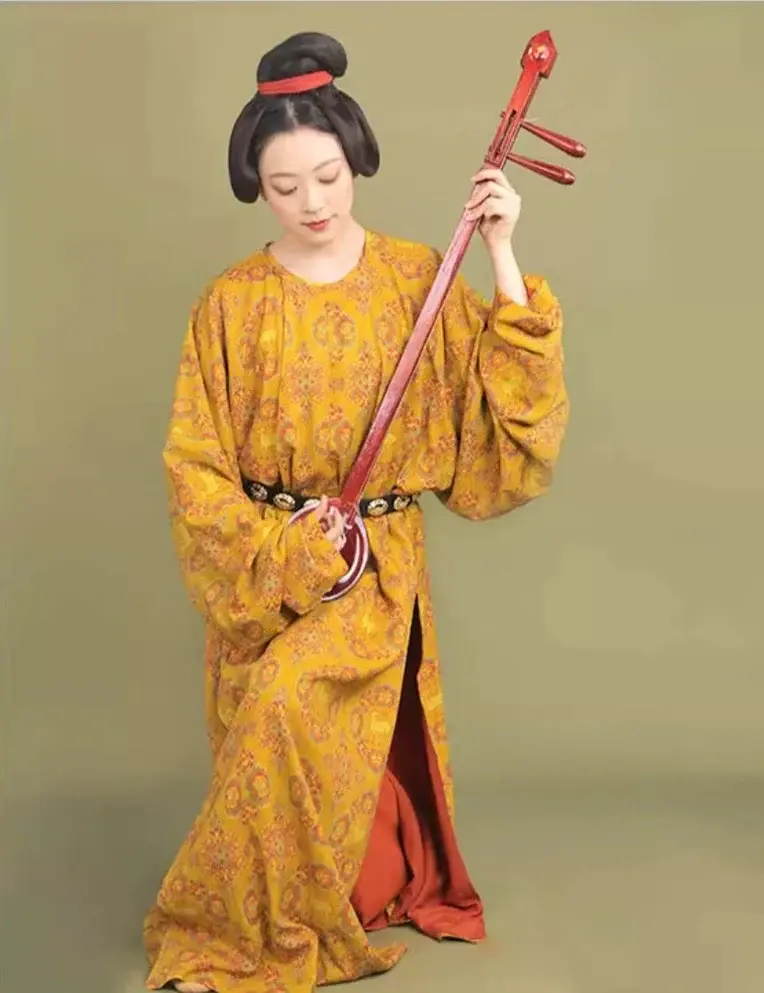

Woman in Yuanlingpao, Reconstruction
Traditional Xianbei Dress, The Inspiration For The Yuanlingpao
Tang Fashions for the Face: Makeup
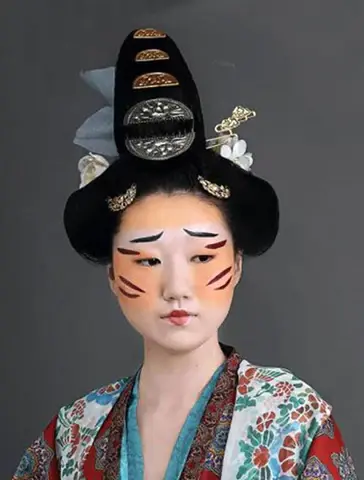
The Tang Dynasty also had some very unique makeup trends, especially during the Middle Tang. During this era drawing slashes or scratchmarks on the face was very popular, reflecting the somber and morbid tone of the era. The women of the Middle Tang also adopted dark yellow blush all over the face from nomadic tribes, and they would pair this with shaved and then painted on eyebrows and dark hued lipstick. These avante-garde trends continued to be in fashion for the rest of the dynasty. Throughout the whole dynasty though, huadian, or flowers painted on the forehead, were very popular. The exact styles fluctuated but the intricate and elaborate nature of the huadian stayed the same. During the Late Tang though, face ornamentation really soared to new heights. Not only would women paint huadian, but they also wore xiehong or drawings on their temples, and dimple dots called mianye at the same time, turning their faces into an elaborate canvas.
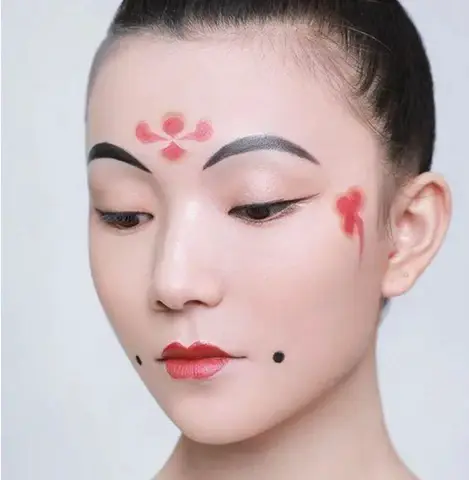
.webp)
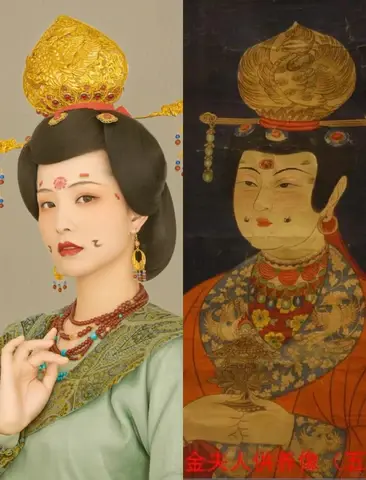
Example of tang dynasty huadian
Example of tang dynasty huadian
Elaborate Makeup of the late tang
Makeup of the middle tang period
The Sui and the Song:
To know how truly special the Tang Dynasty was in the greater fabric of the Imperial history of China, let me give you some context:
Before the Tang Dynasty, during the Sui Dynasty (581-618 CE), women wore ruqun – a robed shirt and long skirt ensemble. Clothing during this era was heavily governed by the strict social structure and the mianfu system, a system that reinforced social hierarchy through restricting certain colors. For example, under this system yellow was considered the imperial color, so only the emperor could wear it, while purple was for the highest officials, then scarlet for the rank below, then green and then blue. Commoners were often restricted to white or black clothes. A version of this system continued into the Tang Dynasty, but was not strictly followed by society women because they had a large amount of dyes available to them and no one was policing their color choices.
After the Tang Dynasty, The Song Dynasty (960-1279 CE) society focused on reinstating traditional Confucian values into everyday life and dress. These values of modesty, material restrictions and dressing according to rank had been sidelined during the time of Tang fashions. During the Song Dynasty age, silks and certain patterns were now reserved for the ruling class and officials, while the lower class had to wear coarse materials and were restricted to only white or neutral tones. This dynasty also banned foreign fashions, as well as certain ethnic garments. Women's clothing went back to covering most of their bodies and women participated less in political and social life in order to conform to Confucian values. The Song Dynasty closed China to outside influence after the Tang Dynasty to rebuild and never quite returned to the vibrancy of the Tang.
Influence Abroad:

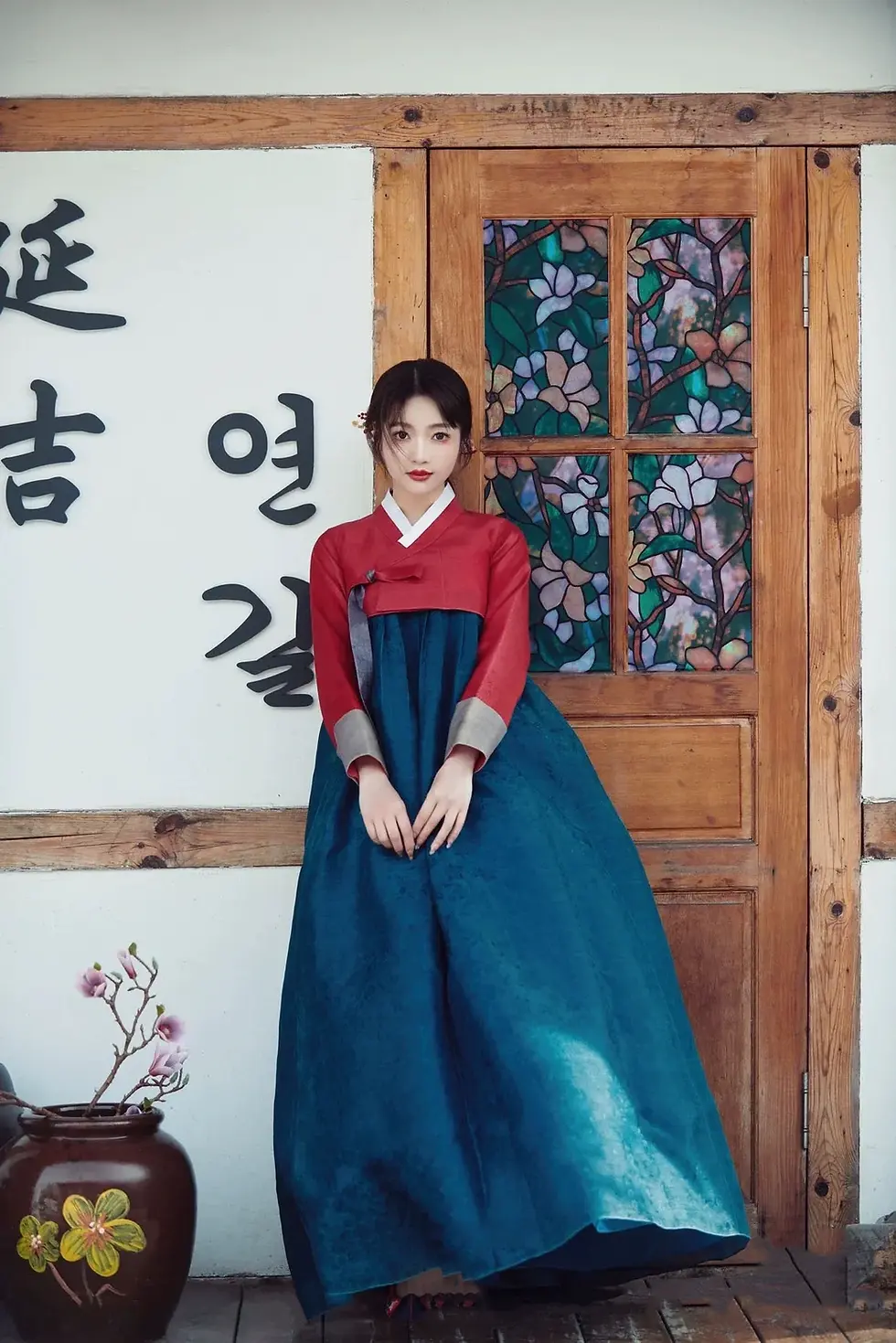
Not only was the Tang Dynasty a Golden Age in Chinese history, but its vibrant culture greatly influenced the nations around it. During the Silla period (57-935 CE) in Korea, Tang ambassadors spread fashions of the day such as high-waisted skirts and banbi (short jackets) to the Koreans, influencing their famous cultural dress, the hanbok. Tang ambassadors also spread their fashions and dress customs to Japan during the Japanese Nara period (710-794 CE). The Kimonos of this era resembled Tang fashion with the long skirts, separate shirt and jacket and higher waist. Members of the Japanese aristocracy permanently adopted the long and flowy nature of Tang-era dress as well as the traditional Chinese left to right robe closure, which remains the standard for kimonos to this day.
korean hanbok
Kimono of the Nara period
heavily influenced by the Tang
The Tang Today:
Today the Tang Dynasty is memorialized in China’s history as the height of Chinese culture. Its traditions and fashions are heralded in modern China as the best of Chinese history, especially in Xi’an. Here the memory of the Tang Dynasty lives on in cultural shows, dances and dress-up shops.
During my trip to China in the summer of 2025, I got the opportunity to try Tang fashion with some friends in Beijing. My American school friend and I, along with our Chinese host students, visited a costume rental shop where we each got to choose a traditional dress among many different eras of Chinese history. We loved the Tang dresses because they were the prettiest, most ethereal and most whimsical. We also had our makeup and hair done in modern renditions of Tang styles. This was definitely an eye-opening experience for me because I not only learned and researched Tang fashion for this piece, but also got to try it for myself! The wide popularity of these kinds of shops and experiences in China really shows how pervasive the past dynasties’ cultures are embraced in the modern identity of China. Here we are 1200 years later still emulating and studying the Tang culture and fashion, its vibrance and artistry continuing to live on.
_JPG.jpg)
My friend and I with our host students,
dressed in traditional Chinese attire


My School Friend Dressed in a Modernized Style of Traditional Tang Fashion
My Chinese Host Student in a High Tang Style
Me, Dressed in a Style Inspired by the Late Tang Dynasty
Works Cited
-
Dragons Armory. “Late Tang Dynasty Lady in Blue Silk Robe.” Dragons Armory, 2019, https://dragonsarmory.blogspot.com/2019/04/late-tang-dynasty-lady-in-blue-silk-robe.html.
-
Dragons Armory. “Tang Dynasty Woman in Veil Hat.” Dragons Armory, 2024, https://dragonsarmory.blogspot.com/2024/04/tang-dynasty-woman-in-veil-hat.html.
-
Ikigai Accessories. “History of the Kimono.” Ikigai Accessories, https://ikigai-accessories.com/history-kimono/?srsltid=AfmBOorVSTscEzgPlu4imLpbx6eMKB67VgWuGg3tZtuxtHHv6VCyvNrT.
-
Nuwa Hanfu. “A Deep Dive into Tang Dynasty Fashion & Makeup.” Nuwa Hanfu, https://nuwahanfu.com/blogs/news/a-deep-dive-into-tang-dynasty-fashion-makeup?srsltid=AfmBOoopShe-x6-3FvU0CY9JJzAGglDq3sXpsGndcEfirRLp-0Rj63wH.
-
Sheygo. “Little Orange.” Sheygo, https://www.sheygo.com/en/products/little-orange?srsltid=AfmBOooq_grblpKHB6GUZj1dj8WseilyJ1QM7jZuSNe9L6oWjNHvMspX.
-
Yandan Hanfu. “Red Blue Hanbok Traditional Ladies Court Wedding Daily Performances.” Yandan Hanfu, https://yandanhanfu.com/products/red-blue-hanbok-traditional-ladies-court-wedding-daily-performances-korean-national-stage-dances?srsltid=AfmBOor5N1Sauh_lU1yA9S6bhXAMiKFNmVmfr8PqP7eCynSe0oG2DlEP&variant=46962995888350